PRESS ENTER TO START
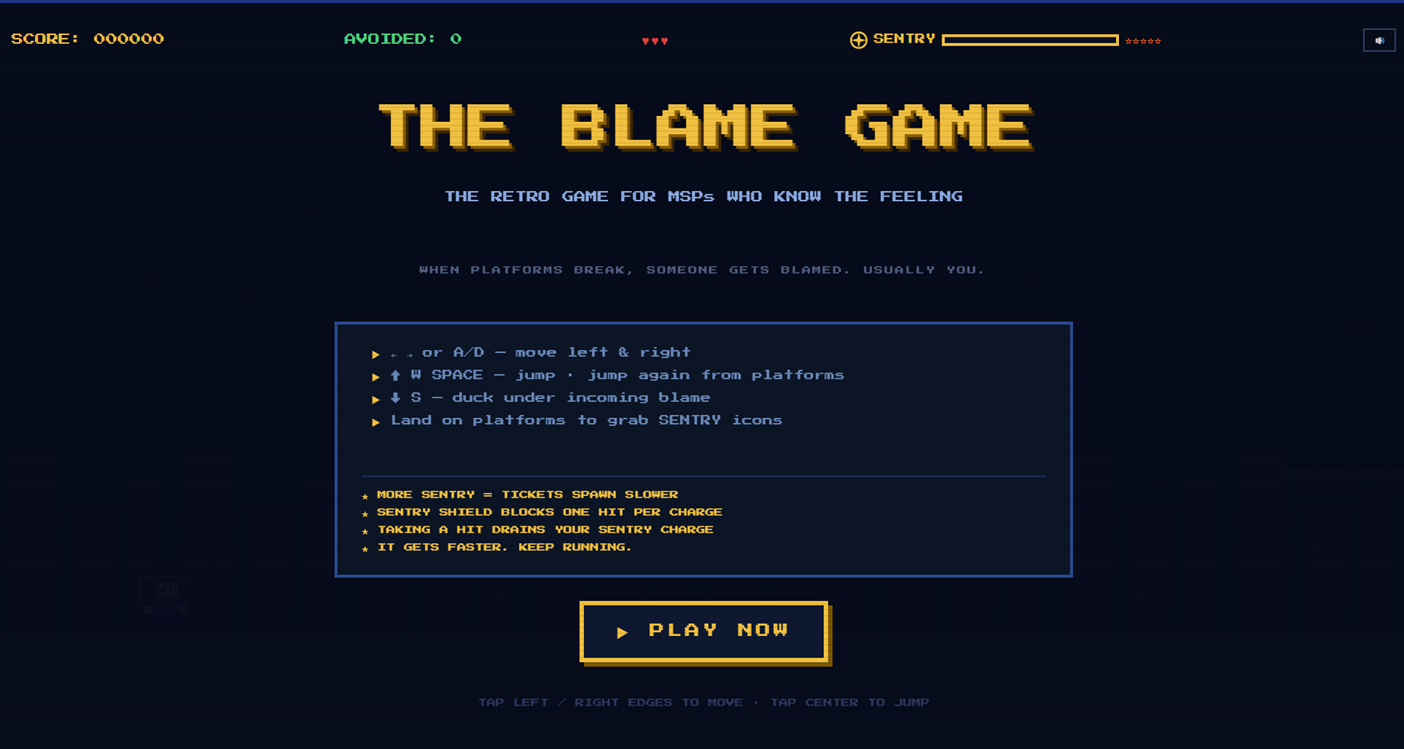
← → choose who gets blamed
SPACE to throw blame
GOAL: Dodge incidents, collect SENTRY stars, keep your SLA intact.
Yes… we literally built a computer game for MSPs. A retro 8‑bit runner where you dodge blame, avoid incidents, and collect SENTRY stars—because if you’re a service provider in ECM/IDP land, you already know the truth: when anything breaks, somehow it’s still on you.
And that’s the point.
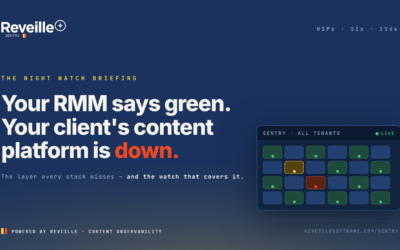
Because the real “blame game” isn’t cute. It’s expensive. It’s exhausting. And it’s usually triggered by the worst kind of failure: the one that doesn’t look like a failure. (Everything’s “up.” Everything’s “green.” Everything’s… late.)
If you missed it, go play it first: The Blame Game. Then come back—because this blog post is built like a game too. 🎮
LEVEL 1: The Rules (a.k.a. “Why is this somehow my fault?”) 🕵️♂️
In managed services, blame follows a predictable physics equation:
Client feels pain → phone rings → you’re guilty until proven observable.
And “proven” is the key word.
Most MSPs monitor uptime. Smart MSPs monitor risk—because in ECM & IDP environments, the real threats often show up as missed SLAs, silent failures, and customer escalations, not dramatic outages.
That’s why Reveille SENTRY exists: it’s designed for MSPs/SIs/ISVs managing ECM, IDP, and RPA environments to deliver service level assurance with proactive visibility—so you can detect issues before customers feel them and scale without adding operational overhead.
Want the straight story on what it is? Start here: Reveille SENTRY.
LEVEL 2: INCIDENT DECK (Pick your villain) 🎴
Below are real incidents you try to dodge from our Blame Game world—because they’re real life with better music.
| INCIDENT CARD | WHO GETS BLAMED FIRST | WHAT’S ACTUALLY HAPPENING | WHAT SENTRY HELPS YOU DO |
|---|---|---|---|
| Queue backlog spiking | “The MSP isn’t scaling workers!” | Throughput dropped after a deploy / misconfig | Catch platform regressions earlier via purpose-built monitoring & alerts for content apps |
| Alerts were never routed | “The platform didn’t alert us!” | Monitors fired… but on-call routing failed | Reduce finger-pointing by proving where the chain broke (before the client notices) |
| Permissions changed | “The ECM is broken.” | Identity/role changes after re-org | Get platform + user-level visibility earlier than tickets and escalations |
| Latency across regions | “The app is slow again.” | Infra / routing / cloud networking issue | Keep investigations fast by correlating platform behavior to symptoms (instead of guessing) |
| Missed SLA window | “Nobody told us.” | Issue known—remediation started too late | Shift from reactive firefighting to proactive detection & assurance |
| Job failures after patch | “It’s the vendor.” | Patch/upgrade fallout in platform layer | Detect breakage in business-critical content workflows—not just server heartbeat |
Hot take: if your monitoring can’t tell you which “villain” did it… your client will. Loudly. 📞💥
LEVEL 3: The Scoreboard (What kind of blame player are you?) 🏆
Our game literally grades you. Which is fun in 8‑bit land and devastating in production. 😅
| GRADE | TITLE | TRANSLATION |
|---|---|---|
| S | SENTRY SUPERSTAR | You don’t chase blame—you prevent it. |
| A | BLAME MASTER | You can spot patterns fast. Still too much guesswork. |
| B | DECENT DETECTIVE | You’ll solve it… eventually… after 12 tabs and 3 calls. |
| C | FINGER-POINTER | Your dashboards are green, your customers are red. |
| F | CLASSIC BLAME SHUFFLER | “Must be the network.” (It’s always “the network.”) |
Now here’s the punchline: most MSPs are forced to play at a C because the tooling isn’t built for the application layer reality of ECM/IDP/RPA services.
LEVEL 4: The Plot Twist (Blame is distributed. Responsibility is not.) ⚖️
This line is a mic drop for a reason: “Blame is distributed. Responsibility is not.”
That’s managed services in one sentence.
Even when the platform is “up.” Even when the monitoring stack is “green.” Even when best practices were followed. The provider is still accountable—without the visibility required to protect the SLA proactively.
So the real win condition isn’t “finding blame faster.”
It’s removing blame from the equation by catching issues early and proving where they started.
FINAL BOSS: How to Escape the Blame Loop (Without Hiring 6 More People) 🛡️✨
Here’s the cheat code stack SENTRY is built around (no Konami code required):
- Catch issues at the platform + user level before the client is impacted
- Deliver SLA-backed service across ECM, IDP, and RPA environments (without adding headcount)
- Create a single pane of glass across multiple platforms/customers/tenants
- Shift from “uptime monitoring” to “risk + service level assurance”
And yes—if you want the short, savage version:
If you can’t prove it, you’ll wear it. 😬
BONUS ROUND: Play, then steal this line for your next client call 🎯
“We’re not here to assign blame. We’re here to assign certainty.”
Now go do the fun part: Play The Blame Game
Then check out what’s powering the whole idea: Reveille SENTRY