
The channel just got a new job title. Nobody mentioned that the old tool stack doesn’t come with it.— THE SENTRY PERSPECTIVE · MSPs · SIs · ISVs
At Pax8 Beyond in June, the channel got a new name for itself: the Managed Intelligence Provider. Not managed services — managed intelligence: AI in the service delivery, outcomes in the contract, a partner that runs smarter operations than the client ever could alone. As a read of where the market is going, it’s right.
But identity upgrades ship faster than economics. Tooling already consumes more than 20% of MSP revenue, and the average shop runs roughly 30 tools to deliver the services it already sells. Every new service line arrived with a new console, a new license, a new integration to babysit. That recurring drag on partner margin has a name: the Tool Tax — and the MIP era will raise it or retire it, depending entirely on what you buy next.
Core Tension
The channel is being told to sell intelligence. Its tool spend says it’s still paying by the console. Tool #31 doesn’t fix that — unless it replaces the visibility work of several, and covers what none of the thirty can see.
Quick answers
What is a Managed Intelligence Provider (MIP)?
How much do MSPs spend on tools?
What is the Tool Tax?
How do MSPs monitor clients’ ECM and IDP platforms?
01 — THE REBRAND
The MIP Era Started at a Conference. It Gets Real in Your P&L.
What the new title actually demands — and where the demand lands.
Pax8’s Managed Intelligence Provider program is the loudest version of a message every channel event is now carrying: AI monetization is the MSP growth story, and partners who stay in break/fix-plus-patching will be priced like it. The MIP promise is outcome-grade service on the systems where clients’ intelligence actually lives — and for most mid-market and enterprise clients, that means the platforms processing their invoices, claims, contracts, and case files: Enterprise Content Management (ECM), Intelligent Document Processing (IDP), and RPA.
Here’s the part the keynote skips. An intelligence-grade SLA is a visibility claim in disguise. Response times, outcome guarantees, AI-era service tiers — every one of them assumes you can see the thing you’re promising about. You can’t sell intelligence-grade outcomes on platforms you can’t see. And the 30-tool stack, for all its spend, was never built to see them.
02 — THE TOOL TAX
Thirty Tools. A Fifth of Revenue. Zero Content Visibility.
The margin math of the stack you already own.
Run the numbers on your own stack and the shape appears fast: RMM, PSA, backup, security, network, documentation — each essential, each another line item, each watching infrastructure. Not one of them knows whether a client’s OnBase queue is draining, an ABBYY extraction succeeded, or a UiPath bot committed what it claimed. The tax gets paid; the blind spot stays.
The 31st Console
A client asks for managed coverage of their document platform. The stack has no answer, so procurement starts on another single-purpose tool — another license, another console, another integration. The tax compounds; the margin thins.
The Blind SLA
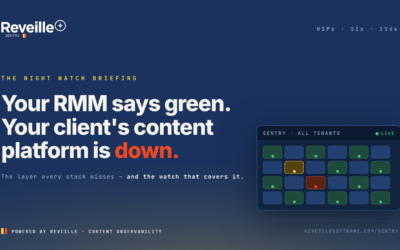
The contract promises response times on the client’s claims workflow. The RMM shows every server green while the intake queue stalls for four hours. The client finds it first. The QBR is now a renegotiation.
The AI Add-On That Wasn’t
The pitch deck says “AI-ready managed services.” The client asks how you’ll verify their document AI keeps extracting correctly in production. The honest answer is hope — and hope isn’t a service tier.
03 — THE REFRAME
Managed Intelligence Needs Managed Visibility
One watch across every platform and tenant — or thirty-one consoles and a promise.
The way out of the Tool Tax isn’t fewer capabilities — it’s fewer single-purpose tools. A consolidation move only makes sense when the layer you add covers what several tools half-did, plus the territory none of them touched. That’s the test tool #31 has to pass: one pane, every client, and coverage of the content platforms where intelligence-grade SLAs are actually won or lost.
| What it adds | Tool #31 (single-purpose) | One assurance layer |
|---|---|---|
| Consoles | One more to staff and reconcile | One pane across every platform, customer, and tenant |
| Coverage | A single function or platform | The ECM, IDP, and RPA platforms clients run their business on |
| Scale model | Per-client setup, per-client cost | Multi-tenant by design — next client, same watch |
| SLA story | More dashboards that don’t reconcile | SLA-backed service your clients can see proven |
| Headcount | Another seat to cover the console | Margins up. Headcount flat. |
Reveille SENTRY · MSPs · SIs · ISVs
Reveille SENTRY is a partner and software program powered by Reveille: one multi-tenant watch across your clients’ ECM, IDP, and RPA platforms. Catch issues at the platform and user level before the client is impacted, prove service levels with reporting clients can see, and expand service lines without adding headcount. Your brand up front. Our watch behind it. Explore the SENTRY Platform →
04 — THE POINT
Two Channels, Eighteen Months from Now
Same title on the website. Very different renewals.
In one version, the partner consolidated the watch before chasing the title: intelligence-grade SLAs on content platforms competitors can’t even see into, renewals defended with proof instead of goodwill, new logos onboarded onto the same pane at the same headcount. The MIP label describes something real.
In the other, the partner bought the title and kept the stack: 32 tools now, margin a little thinner, “AI-ready services” attested by confidence and a slide. The intelligence is in the branding. The visibility never arrived.
The difference won’t be who adopted AI first. It’s who could prove their service levels while the Tool Tax ate everyone else’s margin.
The title is yours either way — Pax8 saw to that. The watch underneath it still has to be built. The watch never blinks. Does yours?
More logos. Same headcount.
ONE PANE · EVERY CLIENT · SLA-BACKED SERVICE