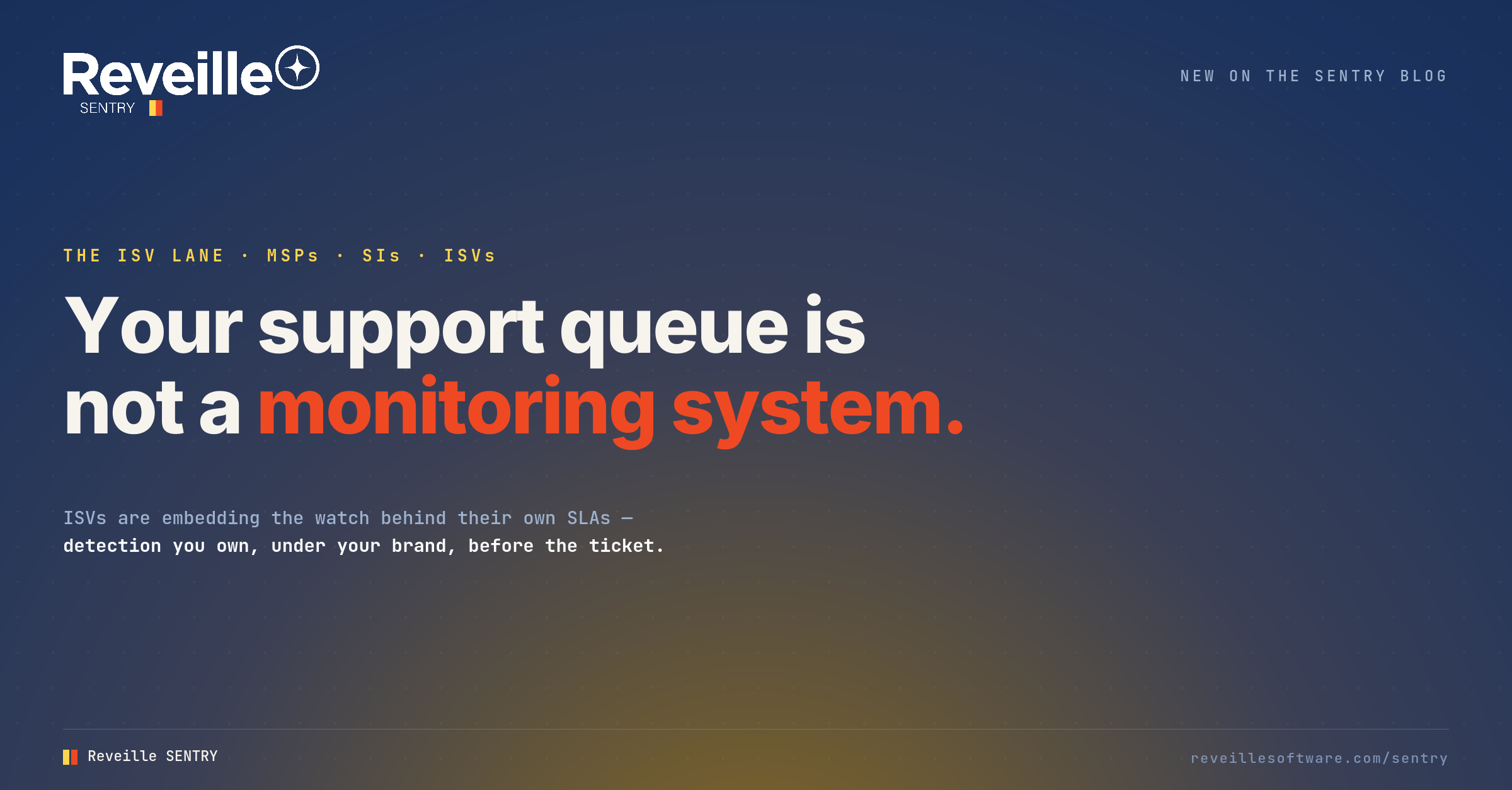
Your support queue is where incidents get reported. It should never be where they get discovered.— The Night Watch · Reveille SENTRY
You built the software. Your customers run it — inside their environments, on their infrastructure, wired into Enterprise Content Management (ECM) and Intelligent Document Processing (IDP) platforms you don’t operate. And when something stalls out there — a queue backs up, a service quietly stops, an integration breaks after a customer-side change — the first signal that reaches your company is a ticket.
That means your customer found the problem, lived with it long enough to give up on it, wrote it down, and filed it. Then the clock your SLA is measured on started — already behind. This is ticket-first detection, and for an independent software vendor (ISV) it is a structural inversion: the team contractually accountable for the service level is the last to know it’s breached.
The Inversion
Support is priced as a cost center and staffed for response. But in most ISV accounts it is quietly doing a second job — detection — and doing it with the worst possible instrument: the customer’s patience.
01 — What the ticket costs
Every ticket-first incident bills you three times
Detection time, reconstruction time, and trust.
First, the detection time itself: the hours between the failure and the ticket, all of it experienced by the customer, none of it visible to you. Second, the reconstruction: by the time your engineer engages, the context is gone — what stalled, when, what changed — so support burns its day rebuilding a timeline the platform could have handed over at the moment of failure. Third, and most expensive: the renewal conversation. The customer’s memory of your product isn’t the ninety-nine quiet days. It’s the day they were your monitoring system.
None of this shows up as a line item, which is why it survives budget review after budget review. It shows up as escalation load, as support headcount that scales linearly with logos, and as accounts that go quiet before they churn.
02 — The alternative
ISVs are moving the watch inside the SLA
Detection becomes something you sell, not something you absorb.
The shift underway in the channel is simple to state: instead of support discovering incidents in the queue, the ISV embeds continuous, application-aware observability of its own product inside customer environments — and stands behind its SLA with it. Detection moves from the customer’s patience to the vendor’s watch. Support engages with the timeline already in hand. Customer success walks into the quarterly review with evidence instead of anecdotes.
Done right, this isn’t a tooling purchase — it’s a repositioning of the support and success organization. The same team, the same headcount, stops being the place bad news arrives and becomes the reason bad news doesn’t. That’s a margin story and a retention story wearing an operations costume.
Reveille SENTRY
SENTRY is a partner and software program powered by Reveille, built for MSPs, SIs, and ISVs. For the ISV lane: more than 1,000 out-of-the-box tests and over 90 automated self-healing actions across ECM, IDP, and RPA platforms, on one pane across every customer and tenant — with private labeling, so your brand stays up front and the watch runs behind it. See the platform →
03 — The point
Two versions of the same renewal
Same product. Same customer. Different watch.
In one version, the customer opens the renewal call with the outage from March — the one their team caught, reported, and waited out. Your success lead plays defense with a discount in reserve.
In the other, your team opens it: here’s the quarter — the issues caught before anyone noticed, the ones that healed themselves overnight, the service level met and documented under your own name. The conversation moves to expansion, because reliability stopped being the topic. The difference isn’t the product. It’s whether detection was something you owned or something you outsourced to the ticket queue.
The support queue will always exist. The only question is whether it’s your early-warning system — or your customer is.
Quick answers
What is embedded observability for ISVs?
How can an ISV support team detect issues before customers report them?
What is white-label observability?
What is Reveille SENTRY?
MSPs · SIs · ISVs
Your brand up front. Our watch behind it.
Put the watch behind your SLA — and walk into the next renewal with the evidence.
Program contact: Wayne Ford · wford@reveillesoftware.com
POWERED BY REVEILLE · CONTENT OBSERVABILITY
REVEILLESOFTWARE.COM/SENTRY